Access All Areas: Researcher
Filed under: Festivals, Post-conflict arts, research | Tags: folk music, Galle Music Festival, researcher, Sevalanka, sri lanka
 Leave a Comment
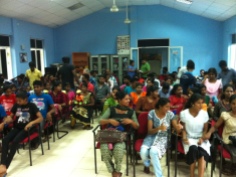
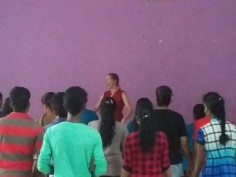
 The Galle Music Festival was an intense whirlwind of activity. For me it started with the “Inspiration” workshop that Sevalanka asked me to lead – this was a session for all the artists the day before the Festival, designed to welcome them and get them interacting and relaxing together. Some of them had been travelling many hours and Galle Music Festival would be their first major event. They were tired, very serious, and not sure what to expect from it all. But the games and creative tasks I introduced worked a treat, getting them singing, clapping, sharing rhythms, songs, and other musical ideas from their traditions and their imagination, as well as laughing and connecting with each other.
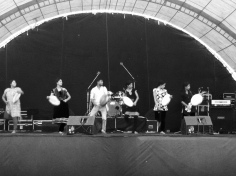
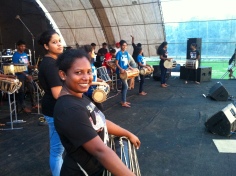
Then there were soundchecks for me to do. I’d spent the last few days observing a drumming collaboration between two all-female drumming groups (one from the North, one from the South), and I’d ended up being roped in to play as part of the act. That was enormous fun, and a very different way to connect with the musicians in the group than simply as an outside observer.
The Festival began with the Morning Program, held in a lovely market square in Galle where a weekly artisan market is held. Stalls were created for the different performing groups where they could display their instruments and costumes, and they gave informal performances in front of their stalls or on the small stage at one end of the market square. The Morning Program at the market had a lovely, chilled vibe, and I was happy to see that it also gave the musicians a chance to interact with each other a bit more, check out each other’s instruments, performances, and so on.
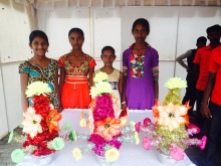
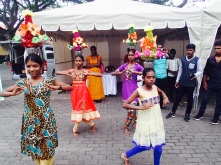
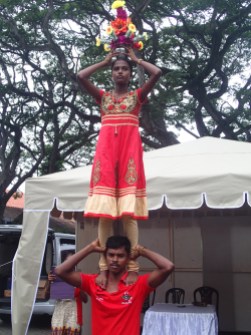
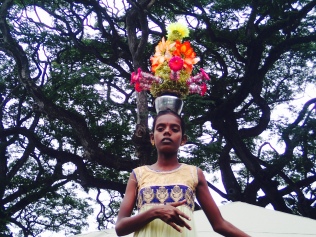

It’s hard to see what is happening in this picture – but she is balancing her head-dress while crouching down to get eye level with the tomato. There is a NEEDLE stuck in the tomato. She then blinks the needle out with her EYE-LID! This was an uncomfortable trick to watch, didn’t look so comfortable to do either.
At the Festival I had two particular researcher tasks – I had a small team of volunteers to help me administer an Audience Survey, and I remained backstage throughout the evening concert to ask each group of performers to complete Performer Surveys. This meant that I was part of the energy and excitement of the performers, as they gathered at the side of the stage waiting for their turn, and afterwards, as they milled about, buzzing with adrenaline, but also (for many) rushing to get their equipment together and their costumes packed away in order to start their long journeys home as soon as possible.
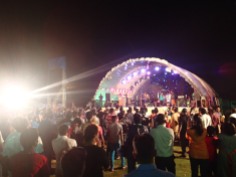
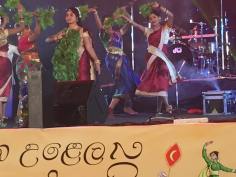
I therefore never really got to see the Festival from the audience’s perspective. That night, it started raining heavily (in fact the rains that came continued unabated and were the cause of Sri Lanka’s devastating floods just a few days later), so the audience was mostly seated further back from the stage under weather-proof awnings. I wonder how it was for them, seeing these performers of diverse folk traditions, many of whom were only experienced in performing for rituals in their own communities? There was an impressive amount of elaboration. I loved these leopard costumes, from a folk theatre group from Mullaitivu District.

Unfortunately I couldn’t get a photo where he turned to look directly at me – but you can get a sense of the detailed face-painting from this shot hopefully.
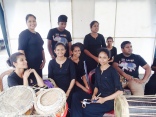
My role backstage, and following on from the ‘Inspiration’ workshop on Friday, enabled me to interact closely with all of these musicians. After attending my workshop, many of the artists greeted me warmly when they saw me backstage, wanted to chat and to have photos taken with me.
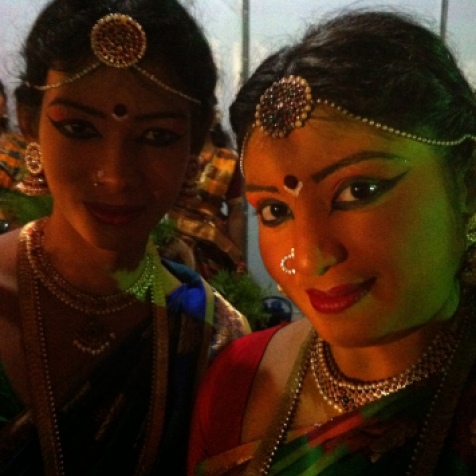
Some of the groups that I’d spent quite a lot of time with – like the all-girl drumming group from Kilinochchi – were particularly sad to say good-bye. One of the girls gave me her pottu (Tamil word for the forehead decoration). We’d first met about 7 weeks earlier, when I came to see one of their village performances and interviewed them about their experiences in the previous year’s festival.
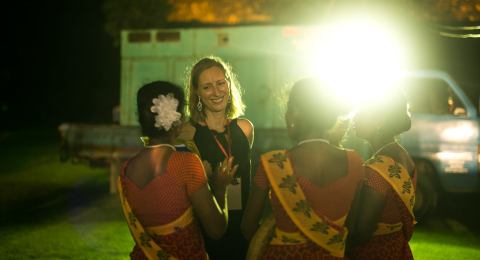
In the end, I had a satisfying amount of Audience Survey completions, and an even more pleasing number of Performer Surveys. My backstage pass for the Festival said “Researcher” on it, which was a definite highlight of my whole time in Sri Lanka! How many researchers can boast such Rock Star-like validation?

Access all Areas: Researcher
Summer weekend on the Oslo fjord
Filed under: Other, travel | Tags: fjord, flea market, Hvitsten, Oslo, summer in Norway, swimming
Comments (3) This weekend was the end of my first week in Oslo and a friend from work invited me to join her for a weekend trip to Hvitsten (White Stone), a small village halfway along the Oslo Fjord. We set off on Friday evening after work, and given how gloriously warm the weather has been this week (+/- 28 degrees Celcius each day), we were not the only people making a break for the coastline.

Wenche’s summer house is a small wooden cabin, nestled among trees overlooking the water. She told us how they’d recently updated the interior, painting it all white (floors, walls, ceilings) and drastically reducing the amount of furniture. The result is an incredibly peaceful, light-filled space, and with the sun barely setting at this time of year in Norway, it was like being inside a cloud!
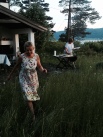
It was her first visit in a while, and Wenche was horrified at the length of the grass, especially as she knew her lawn mower was a temperamental machine that (literally and figuratively) wouldn’t cut it. But Anne and I were charmed.
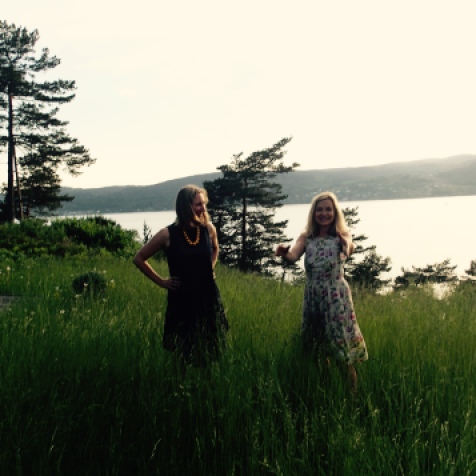
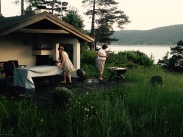
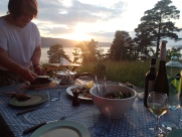
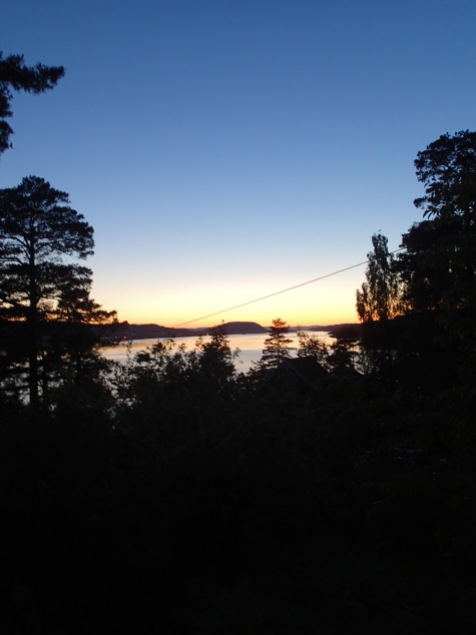
Like Australians, Norwegians love the outdoors and do much of their summer living outdoors. Wenche’s home as an outdoor patio/eating/sitting area, like a half-cabin, with its own fireplace and chimney, long dining table and couch. We ate dinner there both nights. From here the sunset views (starting from around 10.30pm) were magnificent and lasted for hours. I have no idea what time the show finally ended, as I’d gone to bed. But we are nearly at the solstice here (the ‘turning of the sun’, as the locals call it in English) and there are very few hours of darkness each night. In fact, I don’t think it ever gets truly dark.


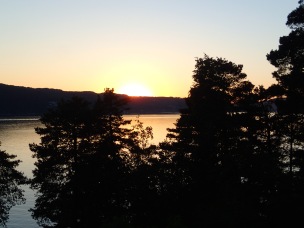
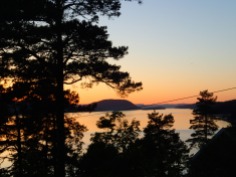
We swam! This was a highlight of the trip. We put on bathrobes made of light-weight fleece (apparently they are Turkish, and used in hamaams there) and walked a little way from the cabin to the local beach. Wenche recommended that the best way into the water was via the ladder, rather than from the shoreline. With the nip in the air coming off the water, I wondered if I really wanted to do this. “Oh. You’re not a real Norwegian,” said Wenche dismissively. That decided it, I was in.

My God, it was icy. ‘Swimming’ is a misnomer; it was definitely more of a dip. No heads went under. I went in twice on Saturday; the second time I managed 24 breaststrokes altogether before getting out. That was pretty good. A neighbour brought out a thermometer to check the water temperature – it was 14 degrees. And we went in twice – morning and afternoon! We cheered ourselves afterwards.
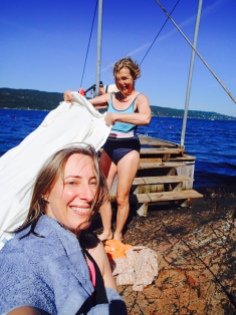
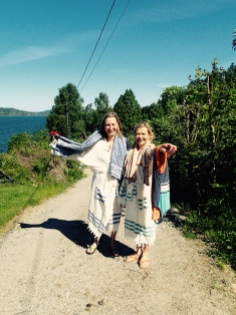
On Saturday I was excited to go to a local flea market. Packing for a 6 month trip where most of it is in tropical Sri Lanka, but 2 months are in much cooler Norway and Scotland, I knew I could use a couple of warmer bits of clothing. The Vestby Flea market (raising money for the local youth marching band) was right place to find these – I bought a warm Swedish-made merino jumper, and a pair of boots. I also found an atlas (my mental map of Scandinavia and northern Europe beyond the Baltic states and Poland had proved wanting in the previous night’s conversation) and an English-Norwegian dictionary. Anne found a very demure 1950s handbag. Good haul.
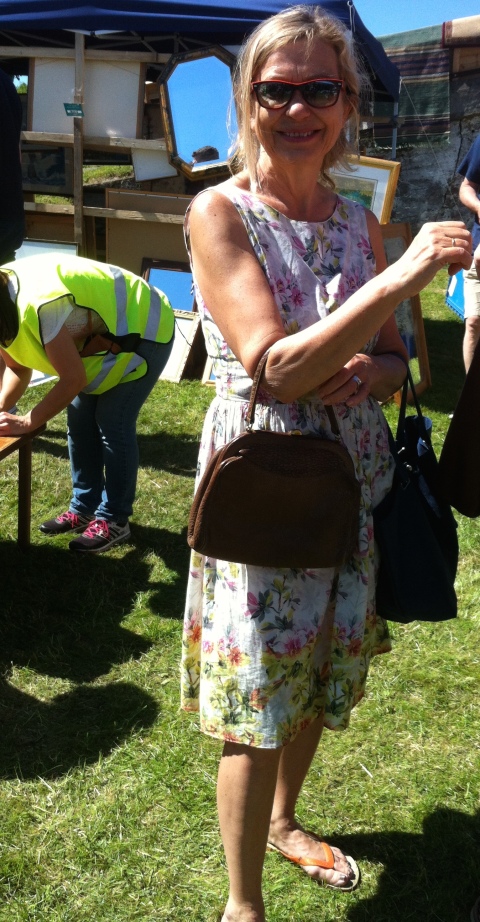
Anne’s new handbag
We also visited Hvitsten village, which is an incredibly pretty little place, with views up the fjord out to the open sea, many beautiful wooden houses, a fairy-tale wooden church, and with its many manicured gardens and public spaces punctuated with figureheads from old ships. The story is, Hvitsten is home to a family that made its fortune in shipping. All the figureheads have been re-purposed as civic monuments after the ships they decorated were decommissioned. Many of the village’s public spaces, along with the church, were also gifts from this billionaire family to the people.
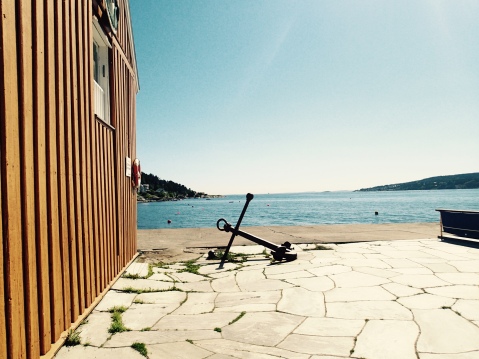


The landscape is filled with wildflowers. Anne told me that purple and yellow are considered “the colours of June”. As well the flowers that we picked near Wenche’s cabin, the roadsides were filled with giant pink and purple lupins.
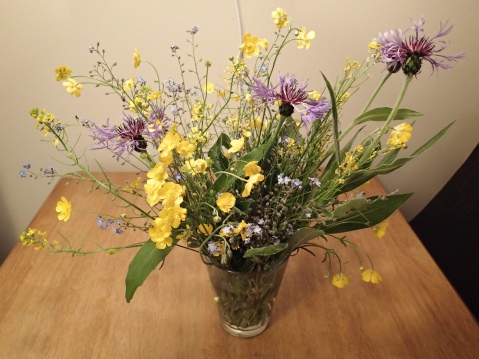
All very pretty, all very idyllic. Nice to see some of the Norwegian countryside (which is so central to Norwegian identity) so early in my stay here. I brought some of it back to my small apartment in central Oslo, the flowers posing here with my flea market haul.

The Paraiyers’ drums
Filed under: Festivals, Post-conflict arts, research, Training musicians, Workshops | Tags: Batticaloa, community engagement, culture, drumming, Eastern Province, ethnomusicology, music, Parai drums, sri lanka, traditional music
Comments (2) 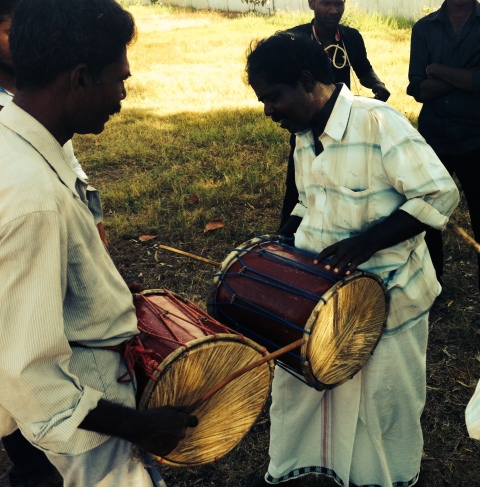
Another part of the Sri Lanka Norway Music Cooperation is the ‘village level performance’ program. Village-level performances give village elders that are custodians of rare and endangered folk forms (music, dance and theatre) support to put on a performance of their traditional work. Support can include funds to purchase instruments, for artist rehearsal time, to prepare costumes and props, and travel costs. This year, one of the village-level performances was in the Eastern province near the city of Batticaloa, and involved musician elders from four different villages.
The model that was used this year was particularly interesting. The musicians were all performers of the Parai drum tradition, which has for a long time been regarded as the instrument of the low-caste Paraiyers (see here for an interesting history of the Paraiyers). Because of this, members of the Paraiyer caste often reject this musical tradition, seeing the drum and its rhythms as markers of lowly status, and indeed, a marker of membership of that caste. Yet the musicians involved in this year’s village-level festival are adamant that the traditions and instruments should be preserved, and they have continued to play for rituals (usually funerals) despite the dismissive and often hostile responses from others in their community.
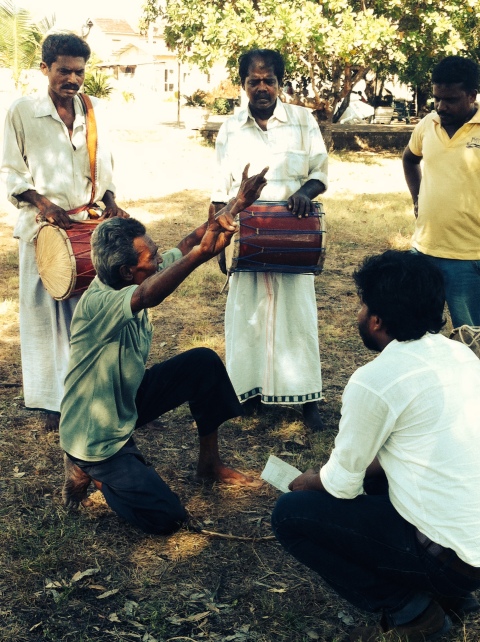
Therefore, building up the status and importance of the parai drum, and recognizing the work of the elder musicians in preserving it was one objective of the village-level festival. The next objective was to increase knowledge of the drum and its rhythms among young students of Tamil music. The Swami Vipulananda Institute of Aesthetic Studies (SVIAS) at Eastern University was a co-presenter of the village-level festival, and arranged for the elder-musicians to rehearse at the university each day in the weeks leading up to the performance. Students and lecturers of Tamil drum and dance worked with them closely, studying the artform. They worked outdoors, under big trees with a circle of benches surrounding the rehearsal space.
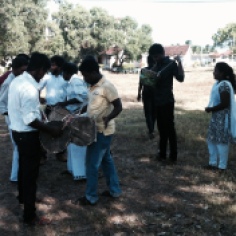
Bringing it into the University was a new initiative for the Music Cooperation, but it served two purposes – of helping to preserve and celebrate the knowledge of the elder musicians by training the next generation of performers, and of sidestepping the hostility towards the Parai drum within the musicians’ own communities.
I was able to observe two days of rehearsals during my research trip to Batticaloa two weeks ago, and these photos are from that visit. I saw a fascinating level of exchange taking place between the elders, the students, and the lecturers. Sometimes it was hard to see who was the authority, or the director of the project. One of the students explained it to me this way:
The elders are the experts in how to play this drum. They know all the rhythms and techniques and forms, and the students are eager to learn this from them. However, they have only performed for village rituals up until now, and they are not experienced in creating a performance for the public. So the students and the lecturers are contributing those ideas.
It reminded me that finding the balance between support and instruction, agency and collaboration, the authority of knowledge and the authority of institutions, and when to be expert and when to step back and give space for the content to emerge and evolve, is complex, messy, and somewhat infinite and imperfect pursuit. This project was tackling these challenges in what seemed to me to be courageous and thoughtful ways. I’m sure they all learned a great deal, and for me, it was an intriguing and thought-provoking process to observe.

Commonalities across boundaries
Filed under: collaboration, Community Music, Festivals, Post-conflict arts, research, Workshops | Tags: dance, folk, Galle Music Festival, language, traditional arts, universities, war
Comments (1) The two young women move swiftly and gracefully to the front of the stage, arms outstretched. In the centre of the stage a young man holds a stylized pose. He is supposed to hold a deep knee bend but it is his first time in this role, and the group’s esteemed director kindly, affectionately tells him he can use a chair for this first day. (Observation journal)
I spent the weekend with students from three Sri Lankan state universities – Eastern, Jaffna, and Peradeniya – as they prepare a performance act for the forthcoming Galle Music Festival. They are working under the direction of Dr Arunthathy Sri Ranganathan, and faculty members from their respective Performing Arts departments. The focus is on traditional music and dance, but Sri Lanka’s multi-ethnic population means that these traditions vary widely across the island. What’s more, with the three universities based in geographically distant and somewhat war-isolated areas (one in the North, one in the East – both areas were epicenters of the civil war that ended in 2009 – and one in the central, mountainous region), opportunities for cross-campus exchanges and collaborations are not in the usual course of student life.

What’s been fascinating to observe this weekend are the points of commonality – social, cultural, and aesthetic – and how these are found and navigated.
The first point of commonality is the students’ shared love of music and dance, and Sri Lanka’s traditional folk forms in particular. If they weren’t interested in these, they wouldn’t be here, because the Galle Music Festival is primarily a festival of folk and traditional arts. (There’s a bit of fusion and rap going on to – but folk traditions are the foundation). The students from Jaffna and Eastern Universities are enrolled in Performing Arts degrees; the students from Peradeniya are members of the ‘Music Society’, a university-wide, student club for those with an interesting in performing music together.
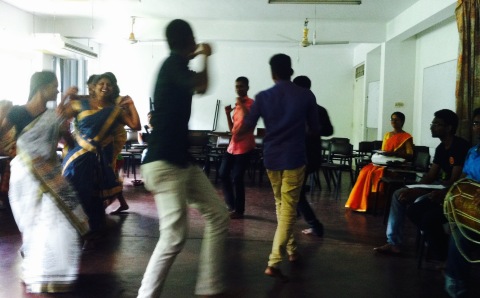
Another commonality is their age and stage in life – they are all university students, young people coming of age in a digital era with phones, photos, selfies and Facebook making up some of the artefacts and shareable commodities of their modern lives.
Finding a common language is more problematic. All of the students are being educated in Sinhala or Tamil at university. Some students can speak both Sinhala and English; some speak Tamil and English. A smaller number speak both Sinhala and Tamil (although most of this generation are across the basics of both languages, they tell me). Therefore, conversations happen in second or third languages, or with the help of mime and gesture and a lot of good-natured laughter.
Each of the groups was asked to prepare a musical number to contribute to the workshop. Some had prepared songs with instrumental accompaniment, others had songs only, others had dances.

In the full workshop with Dr Sri Ranganathan, they each first presented the music they’d prepared. Dr Sri Ranganathan made notes, and then proposed a form that would flow from one song or dance to the next. As they worked through this proposed form, students were roped into different roles. Four girls from Eastern University who’d come along to the workshop as singers found themselves dancing alongside the dancers from Jaffna University, who instructed them in the steps. In the very vigorous and rousing ‘Kavedi’, all of the boys had to dance, with very physical choreography requiring lots of jumps and deep knee bends, and Cossack-style kicks while crouching low to the ground. Impressive – and demanding!
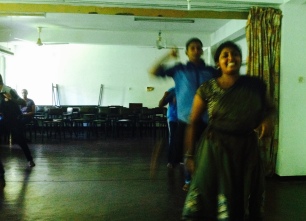
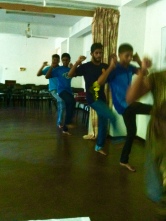
The students stayed in Colombo overnight, so I asked one of the Peradeniya students to keep an observation log of the interactions for me, as I’m interested in the ways that music collaborations can foster more positive intergroup group bonds and relations. She reported back to me the next day that in addition to lots of conversations in different languages, a highlight of the evening was an impromptu jam session, lasting into the wee small hours, when the instruments came out and everyone sang each other’s songs, played each other’s instruments, and generally just hung out and immersed in music the way music-loving young people do everywhere.

The collaborations are one of the new programming strands in this year’s Galle Music Festival. Next week there will be workshops for the collaboration between two all-female drumming groups, one from the North, in the Kilinochchi area, and the other from the Academy of Music and Dance in Colombo. They will be joined by Sri Lanka’s premier women’s vocal ensemble – and possibly by me on clarinet, because the piece that is planned needs a Western melody instrument. It’s a bit of a departure from research observations, but what I love about my work is the constant interplay between music, ideas, collaborations, and intercultural learning. Whether I’m watching, writing or playing, that intersection is where the magic lies.
Music development as reconciliation?
Filed under: Post-conflict arts, research | Tags: cooperation, music, peace, reconciliation, sri lanka
Comments (1) I’ve clarified the shape of my research project this last week. After feeling initially stalled by the idea of examining music activities that were created as music development activities rather than peace and reconciliation activities using music (so many variables! so open-ended!), I came to realize that the question to be answered is about the relationship between music development (the strengthening and development of the skills of different sector actors) and peace and reconciliation in Sri Lanka. Are the music activities having an impact? If so, where, and how, and what are the indicators of this, according to the people taking part? How do these vary across different subgroups of participants?

The connective logic or ‘theory of change’ that can be inferred from the activities goes something like this:
- Sri Lanka’s music sector (including traditional arts practices and the local (professional) music industry) has suffered great damage through the three decades of war.
- By building the capacity of musicians, supporting professionals (e.g. event organizers, audio engineers, lighting designers), and up-and-coming talents (through mechanisms such as performance opportunities, provision of resources such as instruments, training workshops, event experience, etc) you’ll raise the status of the music, and create more engaging and attractive gigs and events. You’ll also facilitate meeting, friendships, and potential collaborations between people of like minds, skills, and interests who have been divided through the recent war.
- As the events become more professional, they will attract people from all cultural groups who will be attracted by the music on offer and to the idea of spending time in a safe, depoliticized space that facilitates meetings with people of other ethno-religious groups.
- The performances of traditional music are also a platform for recognising all that is shared across the different cultures, as well as the value and interest of diversity. Performances and workshops are conceived as ‘culture learning’ platforms, where people can learn about other groups in a holistic way that encourages appreciation and engagement.
- The combination of culture learning and meeting in depoliticized spaces, and the potential for new intergroup friendships and collaborations to be made mean that the Music Cooperation’s impact could also be considered in terms of building peace and reconciliation in Sri Lankan society. However, this potential outcome is somewhat speculative as it has not been sufficiently tested or scrutinised.
Initially I thought that the Contact Hypothesis (from Allport 1954, utilized by social psychologists frequently since then, and further developed through multiple iterations; Arild Bergh used it very effectively as an analysis tool in his 2010 thesis examining music and conflict transformation) would be a useful framework. Contact theory posits that mere contact is not sufficient for reducing prejudice. Certain conditions relating to the context of the contact act as ‘facilitating conditions’, so that mere contact becomes optimal contact. However, a drawback with contact theory is that, over time, the number of facilitating conditions has increased to the point where the actual contact experience bears little resemblance to the conditions that govern the more banal intergroup contacts that are likely to take place in everyday life.
Furthermore, definitions of ‘reconciliation’ and ‘peace’ are undoubtedly contested. People with vastly different lived realities (e.g. those living in the most war-affected locations, or belonging to minority groups) are likely to have differing ideas of what these ideals look like in their lived experience – so whose definition should be used when considering how the music activities have impacted peace and reconciliation in Sri Lanka? Grappling with these questions has led me to a research design that lets the research participants (performers in the annual festivals, primarily) define peace and reconciliation at the outset, and then invites them to explore how – if at all – their lived experience of intergroup interactions, co-existence, and cooperation might have changed through the Music Cooperation activities.
The goals of the research are pragmatic. I hope to identify the key mechanisms and indicators for whatever changes are reported, so that this can inform and shape monitoring and evaluation. There will be other outcomes as well – such as building the evidence base that informs the program logic or theory of change (we may find we need to modify it accordingly). Also, the design allows for unexpected outcomes – things that are not currently part of the picture, but that are of importance to the participants, and therefore could be considered in future Music Cooperation programming.
Meanwhile, Colombo remains hot, hot, hot. Sometimes, travelling home on the bus at the end of the day, I make a mental list of ‘essential’ things I need to buy from the supermarket, just so that I can go and stand in the icy coolness of the local Food City for a few minutes to cool down and just not feel hot. They tell me it is only going to get hotter, these next few months. It’s the best reason I can think of to never buy groceries in bulk.
References:
Allport, G.W., 1954. The nature of prejudice, Cambridge, Mass : Addison-Wesley Pub. Co
Bergh, Arild. (2010). I’d like to teach the world to sing: Music and conflict transformation. (PhD dissertation), University of Exeter.
Dixon, J., Durrheim, K. & Tredoux, C., 2005. Beyond the Optimal Contact Strategy: A Reality Check for the Contact Hypothesis. American Psychologist, 60(7), 697- 711.
New project – music and reconciliation in Sri Lanka
Filed under: collaboration, Post-conflict arts, research, travel | Tags: conflict, endeavour, fellowship, music cooperation, reconciliation, sri lanka
Leave a Comment At the end of last year I was awarded one of the Australian Government’s Endeavour Research Fellowships to develop a research project examining music development activities as a vehicle for reconciliation in Sri Lanka. Fast forward a couple of months and here I am in Colombo, sitting in a small apartment in a seaside suburb, getting my research project off the ground.
I’ve been here a little more than a week now. In that time, I’ve stayed in a guest house in the seaside suburb of Mount Lavinia, flat-hunted in two different suburbs eventually moving into a flat in Dehiwala, jogged on the beach at sunrise several times, eaten different varieties of rice and curry on a daily basis, attended a Carnatic Music Festival and a performance by the Symphony Orchestra of Sri Lanka, and joined the masses at the February Full Moon Perahera (Procession) Gangaramaya Temple in central Colombo. I’ve also had long conversations with colleagues here, mapped my way through the different activities that make up the Sri Lanka Norway Music Cooperation [SLNMC], and begun to scope out what the research project should include.
The Sri Lanka Norway Music Cooperation is, of course, the reason I’m here. It’s a partnership between Concerts Norway and Sevalanka Foundation in Sri Lanka that aims to revive and support traditional music practices, build practical and logistical skills among music industry professionals to raise standards of live performance (for example, supporting the skills development of audio and lighting personnel, music event management professionals, and field recording producers), and engage different sectors of society in music participation. The flagship events of the Music Cooperation are the Jaffna (in the north) and Galle (in the south) Music Festivals, held in either city in alternate years. The festivals attract tens of thousands of visitors, and gather together traditional and contemporary music performers from across the country. Other Music Cooperation activities include workshop programs in universities, a Children’s Festival, training for the next generation of folk musicians (i.e. children) to encourage them to feel proud and excited by the traditional instruments, music and dances of their local area and ethno-religious heritage, a radio program, development of a comprehensive online music archive, and partnerships with three national orchestras (symphony, youth, and oriental) based in Colombo.
So where do peace and reconciliation come into this program of music development? Anecdotally, in all sorts of ways – through the opportunities it provides for performers from around the country to be exposed to each other’s traditional practices and instruments, to present their music to diverse audiences, meet in safe, welcoming, and depoliticized spaces, and importantly, the chance to talk and potential form friendships and collaborations. For audiences, it is in the cultural learning, and the demystifying of the ‘other’ (for during the three decades of civil war, the northern and eastern parts of the country became increasingly cut off and isolated from the capital city, central, western, and southern provinces). The different activities have not necessarily been designed to explicitly address peace and reconciliation needs — they are music activities first and foremost, and they have broad appeal for this reason. But participants and organizers alike feel they have witnessed and experienced positive changes in intergroup relations during the 7 years (so far) that the Music Cooperation has run, and there is a pressing need to examine more critically what impacts the program may be having on reconciliation between country’s divided communities.
And that’s where I come in. My role is to document the changes taking place in peace and reconciliation outcomes, as experienced by participants and organisers across the range of SLNMC activities. I’ll be developing research tools to best capture these changes and also allow for unexpected changes and outcomes so that we get a multidimensional picture of the different ways these music activities may impact people’s lives. I’ll then write a report that can inform future NSLMC activities and establish the baseline for future program evaluations. I’ll be doing this alongside my PhD work which examines music schools in post-conflict countries. There are lots of contextual similarities but also anomalies, and I’m curious to see if and how the emergent themes from my PhD research might play out here.
That’s the broad brushstroke picture of what’s planned; we are now working to narrow down and tighten up the scope. I am only in Sri Lanka for three months (I’ll be doing the write-up in Norway when I am there end-May to mid-July). One very interesting development that I learned of this week is that the presentation I gave for Bangladesh Music Week (at the invitation of Concerts Norway) in November last year on music, human rights, and conflict resolution has inspired a group of students from the University of Peredeniya (Kandy) to initiate a research project on their Music Cooperation activities using Allport’s contact hypothesis as a framework (this was one of the theoretical frameworks I introduced in my presentation). Hopefully I’ll be able to work with them to shape this project and include it as a component of my research.
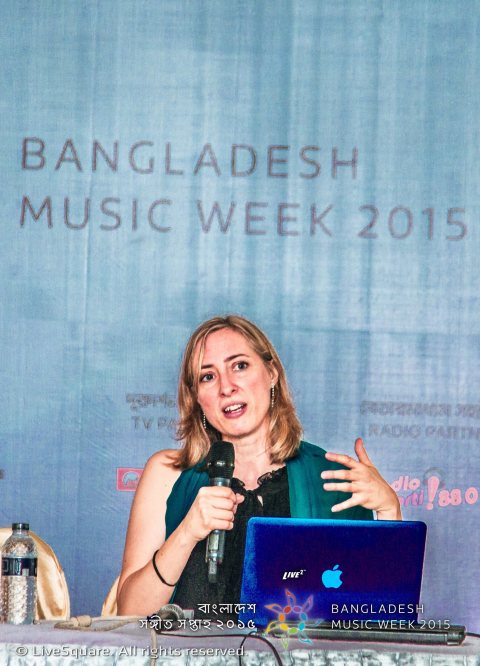
Gillian Howell presenting at Bangladesh Music Week – (c) 2015 Live Square All Rights Reserved
This is my first blog post in many months, and that is largely because life took so many unexpected turns for me in the last 6 months. Sitting here in my airy (but still hot) little apartment, ceiling fan spinning reassuringly overhead, hearing neighbours call to each other in the street below, my stomach full from the egg hopper with caramelised onion sambal I ate for my dinner, thinking about the project ahead, and the PhD, and the whirlwind of events that have made up my life over the last 6 months, I find I keep thinking, “Wow. What a life!” And what a privilege, to get to engage with things you really care about (music, and social justice) in such diverse and fascinating places. Here goes! More soon.
Trends in community music research
Filed under: Community Music, research | Tags: China, conference, keynote, research trends
Leave a Comment I recently gave a keynote presentation in Beijing as part of the Third Community Music Education Summit Forum, hosted by the China Conservatory. I was asked to speak about current trends in community music research, which was an interesting question to grapple with.

Sitting in my official seat, audience behind me
I began by reviewing proceedings from a number of conferences over the last three years, and back issues of the International Journal of Community Music. I also thought about discussions I’d been part of with colleagues here in Australia and overseas. In the end I came up with this list:
Historical mapping of community music activities in countries and regions
It seems to me that in the absence of a neat universal definition of what constitutes community music (and I’m not saying there should be one – just observing its absence and the perennial discussion of “what is community music” that recurs periodically as a result) these kinds of historical overviews that dig into region/country-specific political-economic-social environments, shifts, changes, and trends are becoming increasingly useful documents. Lee Higgins wrote one that for me is definitive of the style, examining the historical context of community music development in the UK; Andy Krikun has written some fascinating accounts of the development of community banding in the United States; Roger Mantie has examined some of the historical shifts (albeit the a focus on language and discourse in key journals) of the wind band scene in Canada. Shorter overviews of other countries’ contexts for current practice were included in ‘Community Music Today’ (Veblen, Elliott, and Messenger, 2012). I’m hopefully the trend will expand further, and that we’ll see similar studies emerging from regions that are less-represented in the community music literature thus far.
Typologies and conceptual frameworks
Related to these alternatives to a universal definition is a continued effort to offer frameworks or conceptual models for understanding community music activity. These turn up fairly frequently, and depending on what is being examined, offer varying degrees of usefulness (which means it is useful to have multiple options). Huib Schippers unveiled a very interesting set of three domains of community music at the recent Asia-Pacific Community Music Network meeting that draws upon his extensive work on music sustainability and eco-systems. The ecological perspective illuminates different aspects of music activities and projects – for example, providing a tool for understanding the community expectations of a community music intervention, which may differ from the expectations of its organizers.
Online community music communities
There’s a growing number of really interesting studies that explore this topic from different angles – pedagogy and informal learning, communities of practice, materials, different applications of technologies, as a participatory cultural practice, limitations and possibilities, and so on. The International Journal of Community Music devoted a recent Special Edition to this topic.
El Sistema and Sistema-inspired activities
I’ve also observed a growing presence for Sistema-inspired programs in community music research. The twin goals of social care and music learning, and the complex contexts in which these projects work make these activities a good match with community music research. At present, research on this topic may still be more frequently directed toward pure music education forums, however, I’m anticipating a continued gradual positioning of this research in the community music sphere. What’s more, the next group of PhD scholars and researchers interested in examining a Sistema-inspired project can read an inspired/inspiring list of potential research questions in Roberta Lamb’s review of Geoff Baker’s ‘El Sistema – Orchestrating Venezuela’s Youth’. See pp. 178-179, here.
I closed the keynote presentation with a series of ‘hot tips’ – topics that I predict will emerge as future trends in the next 3-5 years:
- Gender in community music. It hasn’t come in for much attention thus far, but it’s an important area for examination. Music is an extremely gendered practice; the paper “From snuggling and snogging to sampling and scratching: Girls’ non-participation in community-based music activities” (Baker, Sarah, & Cohen, Bruce M. Z, 2008) is well-worth a read for an initial examination to how this can play out in community-based music activities.
- Pushback against the ‘intervention’ model as the gold standard towards more organic, community-driven music approaches. I predict this will come about as non-English language community music work gains profile in the research literature. The relevance of this difference in emphasis of what practices look like and deliver was particularly evident at this year’s Asia-Pacific Community Music Network gathering (Japan, July 2015); indeed, the increasing ‘pushback’ was a topic that was discussed in the closing comments of that conference.
- Happiness and Joy. I predict that as researchers we will begin to look beyond the instrumentalised focus of many community music activities (or of their organisers’) to put the spotlight more firmly on participant experience, which will foreground some of community music’s least measurable, most subjective outputs – such as experiences of happiness and joy.
- Street bands and music-as-activism. I predict we will see an increase in the visibility of these kinds responses to social issues, and consequently they will begin to feature more prominently in community music research. The activities are not new, but I predict a revived interest in the dynamics of this kind of music-making as it interacts with local and global contexts for change and citizen action.
What do you think? Are there trends in community music research that you’ve observed that could be included here? What are your own tips for the next ‘hot topics’ in community music research?
Return to China
Filed under: Community Music, travel, Workshops | Tags: China, conference, keynote, Xinjiang
Leave a Comment I loved this return visit to Beijing. It’s always nice to be hosted, and the Chinese are wonderful hosts! My plane touched down at 3am, and when I finally emerged through the gates into the public area (that airport is enormous, it took me ages to walk through given I was still recovering from my recent surgeries), two very tired but smiling student volunteers from the China Conservatory were there to meet me.

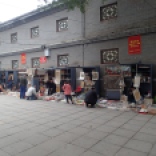
My first day was free of work tasks so one of the volunteers took me to the Panjiayuan antiques market where traders from different parts of China were selling antiques (some real, some less real) and handcrafts. I bought some gifts for family, friends and friends’ children, but mostly just loved the browsing and people-watching.
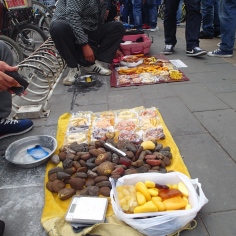
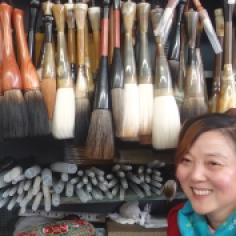

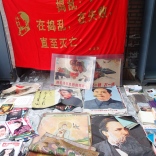
We also went to Beijing Glasses City. This is a mall filled with spectacle-sellers, lens-grinders, and optical accessories stalls. My student guide, Wang (although I later suggested an English name for him – Max – which he loved and immediately adopted) is from the Xinjiang Autonomous Region, up in the north-west, sharing the border with Kazakhstan and Kyrgystan, so Beijing Glasses City was a new discovery for him. I chose frames and got my eyes tested and had new glasses made within 30 minutes.

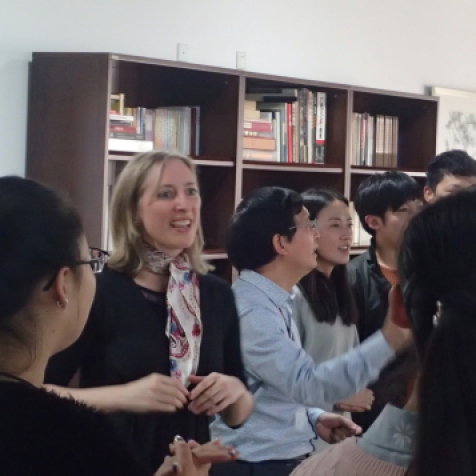
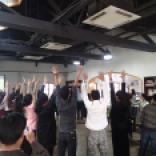
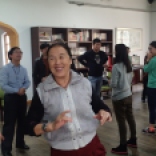
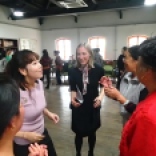
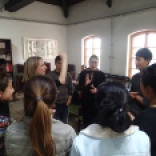
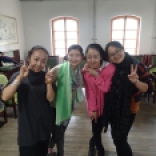
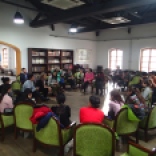
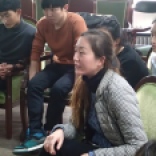
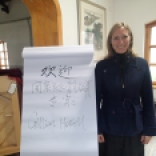
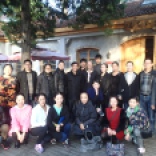
The next day I led a music workshop for community music and dance teachers from around China, who were in town for the Community Music Education Summit Forum (I love that the event was both a summit and a forum). We did a range of collaborative composition tasks, using voices and body percussion. They were a great group. Though, I was reminded how tricky it can be to work with an interpreter in composition tasks. Sometimes, the pace of the work moves very quickly and I want to be able to give a key direction or piece of information in a very specific moment. It’s tricky to remember that if I just speak when I want to speak, the group won’t understand what I’m saying, and the energy behind it can translate as stressful urgency, rather than just in-the-moment encouragement that progresses the composition along in a critical point in time. A couple of times I really had to bite my tongue to give the interpreter a chance to move across the room to me and translate my instruction for the group.
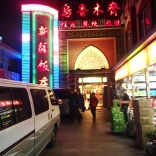
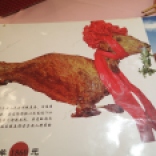
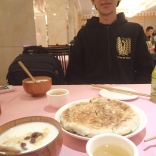
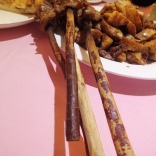
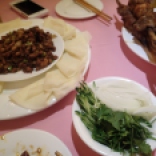
That evening, Max and I found a Xin Jiang restaurant where we ordered too much and had a fantastic meal of very Central Asian food. Max took the leftovers back to the dormitory for his room-mates. I was pretty excited to discover this new cuisine, although I also realized it was similar to I had had at the Uyghur restaurants in Kazakhstan. I fell in love with the sturdy wooden kebab sticks they served our meat on, and the wooden spoons that they served our yoghurt with. Max asked the waitress if I could buy them. She said no.
My last day in Beijing was the day of my keynote presentation. We travelled together to the conference venue (a community college). There were a number of formalities at the start of the day, and I joined the group of presenters on the stage for many of these. My presentation was well-received by the group and afterwards I had the chance to speak with a number of community music educators. One told me she was delighted that I had spoken about the importance of acknowledging happiness and joy in community music. “That’s what it is all about,” she stated emphatically.
In the afternoon, the student volunteers took me to see the China Conservatory. They walked me through the grounds, showing the impressive practice annex, and the student dormitories where they both lived. We had tea together in a small Xinjiang café in their basement student food hall. I fell in love with the beautiful teapot they served our green tea in and wanted to buy it. This time I didn’t ask though. It isn’t quite right to offer to buy the serving paraphernalia in every restaurant you go to, is it? Max had brought me some Xinjiang snacks, which consisted of extremely hard round crispy breads, which he called naan. They were so hard I wondered if I might break a tooth. It felt a bit like trying to eat an enormous rusk.

Then the time came for me to head to the airport, and both Max and Heidi (the second student volunteer) accompanied me there. They helped me with the check-in, organizing for me to have some assistance getting to the gate so that I wouldn’t have to carry my bag too far in my post-surgery state. Heidi had been the main person I’d communicated with prior to my departure and she knew I’d been ill, so was particularly concerned to take care of me.
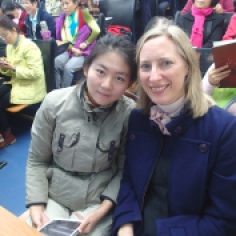
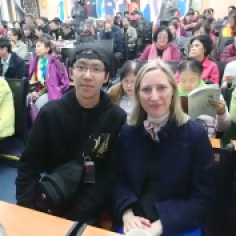
They both sent me text messages wishing me well in the couple of hours between our farewell and my take-off. They were the sweetest volunteer helpers ever! Thank you Max and Heidi for making this visit to China so delightful!
Wrapping up Community Music Leadership for 2015
Filed under: Community Music, Training musicians | Tags: leadership, Melbourne Polytechnic, training, workshops
Comments (1) In second semester each year I teach a 13-week Community Music Leadership course as part of Melbourne Polytechnic’s Bachelor of Music degree course. As part of their assessment for this subject, each student organizes to spend a minimum of 12 hours in a community music project, where their main goal is to observe an experienced music leader in action (rather than assuming a leadership role themselves). They are required to blog about these experiences, and the last class of the semester is run as a discussion forum, where everyone can share their reflections on what they have learned through the placement process and course content across the 13 weeks.

A student-led workshop exploring ‘haptics’ – a way of communicating musical ideas to deaf-blind musicians
With 28 students in the class, there were too many people to accommodate a short presentation from each individual about their placement experiences, so instead we focus on small group sharing and reflection, followed by group presentations to the rest of the class. We had this final class on Thursday and it led to some lively discussion. Here’s a summary of some highlights:
Acceptance and non-judgment
A group of 5 students that did their placements in settings where the main participant groups had particular vulnerabilities/care requirements spoke very openly about how confronting and challenging some of their experiences had been, particularly during their first visits. They were working in settings such as juvenile justice detention, an immigration detention centre, a drop-in community centre for homeless and mentally-ill people, and a school for autistic children/youth.
A main learning that they described was the importance of acceptance as a central ethic and value. One described how, while he knew that some of the young people in his placement site had committed very serous crimes, he realized that he didn’t need or want to know who had done what. Instead, his role as a musician and music facilitator was to accept everyone in the group as fellow human beings, sharing a common interest in music. Another suggested that, on face value, some of the people he interacted with in his placement looked like people he might have wanted to avoid if he passed them in the street somewhere. He learned how quickly those preconceived ideas would block any genuine connection he could make with the music participants, that he needed to discard those notions of ‘knowing’ people and come to the experience in an open, warm, and accepting way.
This is the hospitality that is inherent in community music – what Community Music Victoria trainers call the “active welcome” that intends to draw people into the group, to feel welcome, valued, appreciated, and free to be themselves, without fear of judgment or not being “enough”.
Excellence
A dilemma that caused some frustration for one group revolved around ideas of “excellence”. The students in this group had all completed their placement hours with the same community orchestra – not a symphony orchestra but a very lively, informal group that plays mostly Balkan and East European music. Their frustrations revolved around a sense of passivity they perceived among the group members, and an apparent casualness about musical attainment and mastery. They felt that more effort could have been made in this group (by the leader? by the students themselves?) to achieve a higher standard of performance (they observed that the group members didn’t necessarily use the resources that were prepared for them to help in their at-home practice and learning; also that the group was working towards a very ambitious concert program that allowed little time to be spent going over musical details). Underlying their frustrations seemed to be a plaintive cry of “Why don’t they want to play better? Why isn’t that a priority for everyone here?”
Their arguments for a greater focus on mastery/attainment/excellence centred around the idea that a sense of ownership towards the group and its music could be achieved through participants being invested in their own progress and gradual mastery… they were less aware of the fact that for some members of the group, the pressure of having to ‘master’ their instrument or the music can detract from their enjoyment of the experience.
Their grappling with this highlighted the way that ‘excellence’ in community music activities often does not refer to musical excellence alone. It is also about excellence of experience, about quality of relationships, and about being able to set and influence the agenda of a group in collaborative ways.
Values
A third point of discussion was of the importance of identifying and articulating your values, so that these will form the foundation of everything that you do, and can also be used as a central point of reference in decisions about programs, directions, priorities, etc. The student that raised this as a key learning for her had spent sometime working closely with the administrative staff of Community Music Victoria, and CMVic’s values are certainly front and centre of everything they do, as their website attests.
Inclusion and exclusion
Students also debated the inclusion/exclusion dichotomy quite vigorously. They considered the paradox of “inclusive” projects where particular groups who might be typically marginalized from the mainstream are targeted for participation – does this then exclude the mainstream? They also observed the way that ‘opt-in/out’ projects (where participants decide for themselves the extent of their participation, interacting and participating according to their own interests and comfort levels) create space for people to exclude themselves – and does this therefore mean they are less inclusive than they intend? Can you be actively and deliberately inclusive without excluding some? In other words, are they essentially two sides of the same coin, and one cannot be present without the other?
We didn’t finish the student forum with any conclusions, more just a strong sense of the unresolvable nature of many of these questions. In community music there may not be any truly hard and fast rules of what to do and what not to do. Rather, the facilitator’s willingness to remember that “it depends”, and to remain alert to the subtle shifts and nuances within every group, adapting and adjusting in response to what they read and observe, is what determines their actions, choices, and leadership throughout the workshop and the project.
My hope with the Community Music Leadership course is that the students – most of whom are in the final semester of their music degrees – will recognize community music leadership as a viable and (hopefully) artistically-satisfying and inspiring part of the portfolio careers that many of them will go on to build. They were a good bunch of students (they always are), and I finished the semester reflecting on how satisfying it is to teach a subject that I feel so passionate about to a generally personable, curious and open-minded group of very versatile and talented musicians.
Memories of my time in a post-Soviet Children’s Camp
Filed under: Other, travel | Tags: Artek, children's camp, Crimea, holidays, memories, Soviet Union, Young Pioneers Camp
Leave a Comment Probably the most famous of the Soviet Union’s ‘Young Pioneers’ Children’s Camps was Artek, on the Crimean Peninsula. Positioned along the sparkling blue waters of the Black Sea, it was the first Young Pioneers camp, opened in 1925, and grew to become a vast complex, and an extremely prestigious place to go. In the European summer of 1996 I made my way to Artek to spend a few weeks as a guest vozhaty – group leader. I spoke a little bit of Russian and was up for an adventure. This weekend, Artek is celebrating its 90th birthday. Sveta, one of the vozhaty that I befriended there 19 years ago invited me to write an article with memories from my visit. This is what I wrote.

View of Artek from Ayu-Dag mountain
I arrived at Artek somewhat unceremoniously. It was late July, 1996. I’d flown to Odessa, and had planned to travel by train to Crimea. But then I met a group of other travellers in the visa queue who were also travelling to Crimea but by private bus. I asked if I could hitch a ride with them to the city centre because I had heard there was no public transport from the airport. Instead, they persuaded me to travel to Crimea in their bus with them. I agreed, but it was a big mistake on my part. It was an awful journey that took three times longer than they’d said it would. It was a Friday, and I had arranged to call the Artek office from Odessa before they finished work for the day to say what time I would arrive by train in Sevastopol. But the private bus never stopped so that I could phone. No-one had mobile phones in those days. I also had no chance to change money, so I couldn’t buy myself any food and had no water. It was a very bad decision and to this day I regret hitching a ride with that group of Germans, friendly though they were, and missing the chance to see Odessa and travel by train to Crimea.
They dropped me in Sevastopol the next morning, a Saturday, and as I’d been warned, I couldn’t contact the Artek people to say that I’d arrived, because the administrative office was closed. So I boarded a bus that was travelling to Hurzuf, which I knew was the nearest village. As an Australian, I was used to travelling independently, but it meant that I arrived at Artek (with the help of some friendly Hurzuf locals) with no prior warning, which I think was a bit of a shock and inconvenience for everyone.

Hurzuf/Гурзуф
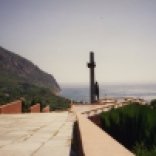
Kiparisniy (Cypress) Camp is the camp that is closest to Hurzuf, and that is why I ended up at Kiparisniy Camp – because I could walk there. My visit to Artek had been organised by a youth exchange organisation in Riga, and I think I was supposed to go to Lazurny, or one of the more modern, flagship camps designed by famous Soviet architects. Kiparisniy was already full, with no spare beds. It was also old with lots of problems with the plumbing. But Kiparisniy Camp was beautiful with its tall cypress trees and views of the ocean, and the people I met welcomed me so warmly that I was happy nobody tried to make me move to another camp, once that first weekend had finished.
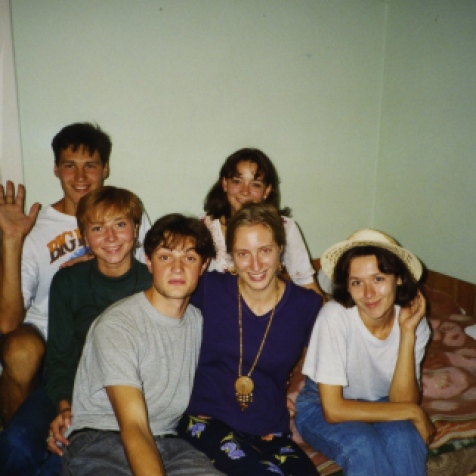
Meeting the vozhatie
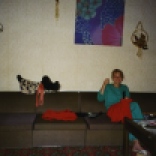
It’s funny that most of my photos are of life in the dormitory shared by the camp’s group leaders (vozhatie) . It would appear that I never went anywhere else! But it is also appropriate, because my memories of Artek are mostly of the people.

Right from the beginning the wonderful, indefatigable, funny, kind Sveta took me under her wing, and we’ve remained friends ever since. She had less English than I had Russian, but she had patience and energy and ingenuity, and a very inclusive spirit. I remember her approaching me that first evening saying, “A bunch of us are going out to eat arbuz – Do you want to come?” I had no idea what arbuz was but I went anyway, and learned that arbuz meant watermelon. A group of us sat and ate slices of juicy watermelon and I played my clarinet for everyone, sitting outside, around the edge of a fountain. That was my first evening at Artek.
Tourist Games
One of the first excursions I went on during my Artek experience was to play what were described to me as “tourist games”. In English I think we would call it orienteering. I had never done anything like this before, and I’ve never done anything like it since. With another young woman who was also a short-term visitor I was taken by car to the middle of a forest, and, using some clues that made very little sense to me, had to find our way to an end point, out of the forest. Fortunately, vozhatie and older campers popped out from behind trees every now and then to help us along the way.
One of the tests we had to pass required us to use sticks and stones to ford a wide stream. We were hopeless – our feet got very wet. Another test required knowledge of different kinds of wood. A serious, slightly world-weary girl scout asked us to choose which from among three bits of wood was the one we should use to start a fire, and which to use to keep the fire burning. To me they all looked like random sticks, so I just guessed. The girl scout sighed heavily, and matter-of-factly told me that I had failed. In fact, this one (she pointed to it) was Wood Type X, and would be the quickest to catch alight, and that one (she pointed to another) was Wood Type Y, and was a slow-burning wood. So there. She let us go past anyway. Thank goodness. In the end my team failed the Tourist Games. I think we got collected by a bus at some point, because we were so slow and so far behind the other teams. I laugh at the memory now, because I know that I really had no idea what was going on, nor how to succeed!
Another excursion I remember was going on a walk to see the marble caves. I think this might have been on my second day at Artek – it was very early in my visit and I didn’t really know anyone. A girl named Luda befriended me that day, and Luda was a great companion for the rest of my stay.
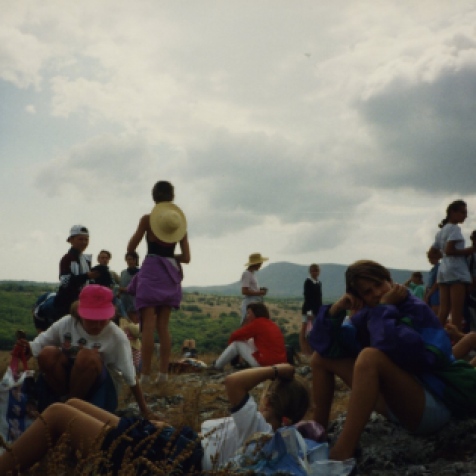
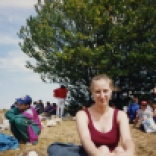
Artek days were very, very long. The vozhatie got up very early, because they had to get their group of children up and out of bed – which meant rising before them. Then, in the evenings, after the children were sleeping, their free time began, so they would socialise and then go to bed very late. There was nap-time in the afternoons. But how did everyone keep their energy going?
The earliest start was the day that my group went to climb Ayu-Dag, the high “bear” mountain that overlooks the whole Artek complex. We left long before sunrise – maybe at 4am? We went first to the kitchen, where the staff had prepared packed lunches and bottles of boiled water for us (all the drinking water in Crimea had to be boiled at that time). We travelled awhile by bus – or did we walk from the camp? – and then we started climbing upwards. When we reached the mountain summit Sveta painted coloured stripes on our faces. These were to say that we’d climbed Ayu-Dag. On the walk down we had wonderful views across all of Artek.

Some of the Ayu-Dag group
Swimming in the Black Sea
I remember being fascinated by the daily swimming program. The sea water had been divided into lanes, with all the children’s groups assigned a lane each. When a whistle blew, they were allowed to run into the water. No-one was allowed to put their head under water (I wasn’t sure if this was so that they didn’t drown, or because of ear and eye infections). Time in the water was strictly monitored and when the whistle blew, the children had to get out again. During these rest times, I remember hunting for shells with some of the children. We tried to find shells that had dirochka – little holes – in them (you see, I still remember these words), that could be threaded onto leather strips and made into necklaces. Beaches are prominent in my Australian childhood memories, and the shell-gathering was a familiar activity for me. However, the restrictions around being in the water were very strange for me, and I admit I found the whole regimented process quite bizarre. Australia has a strong beach culture. We see access to beaches as something akin to a human right!
Arts and culture
There was so much skill and talent among the vozhatie and the children! I remember there was a ballroom dancing competition while I was there. A whole crowd of vozhatie took part. In Australia, there is no way a random group of trainee teachers and youth leaders would know how to ballroom-dance. And no way they would take part in a competition – unless it was supposed to be humorous. I have photos of the costume preparation – whole teams of vozhatie sewing black trousers and short red skirts for the dancers.
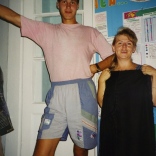
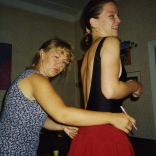
I remember some extraordinary young singers – they had won a local competition, and both first- and second-place getters had come to Artek as part of their prize. They were clearly on track to be the pop stars of the future. Also while I was there, a dancing troupe from Belarus was in residence, and gave several performances.
I remember playing duets with a young saxophonist named Vika. We played the Theme from Love Story [Legende Lyubimiy] together, with me improvising a harmony to her soaring melody. I led workshops for a small music group, and together we wrote songs and improvised. I also joined with two other vozhatie to sing lullabies every night in the dormitory for the 8-9 year olds. I loved doing this, and learned several Russian songs in 3-part harmony in the nightly singing sessions.

The singers, thumbing their way through my Russian dictionary
Life in the dormitory
Sveta celebrated her birthday during my time at Artek. She organised an elaborate party, with all sorts of tasty food and lots of Georgian wine. We re-arranged the girls’ dormitory to make it look festive and used every table in the building to make a long table in the centre of the room. Later, we hauled our mattresses up to the roof and slept outside, under the stars.
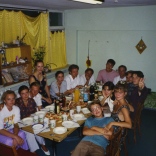
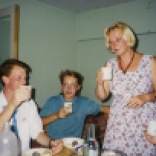
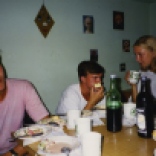
The vozhatie’s dormitory had some definite plumbing problems. I hope nobody minds that I remember this! For me, it was part of the adventure – but I was only there 2 weeks. Probably it was more annoying for everyone else. I remember the water only came out of the taps once in the mornings and once in the evenings. People would make sure to fill up all the buckets each day and we would use this stored water to make tea, wash hands, and flush the toilet. I loved the colourful labels that were on the bottles of Georgian wine we were drinking, and I remember soaking the labels off the bottles in the buckets of water, then drying them between the pages of my journal. People thought wine labels a fairly odd thing to collect, but I remember Sveta sending me some more labels, years later. Thinking back now, I’m not sure how hygienic it was to soak empty wine bottles in our water storage.
Hot water was more unpredictable. I learned that when someone yelled out “Goryachaya voda” (hot water) in the dormitory building, it was a cue for everyone to take advantage of the opportunity to have a hot shower. People would run into the corridors carrying towels, and head down to the basement showers. No-one could ever be sure how long the hot water would last. Goryachaya voda is Russian vocabulary that I learned in Artek, and that I have never forgotten!
Also ‘smyena’. It took me a long time to work out that there were two sitting sessions for each meal. I was supposed to know which smyena – first or second session – my group had been assigned each day. I didn’t understand this, and kept turning up whenever I was hungry. This meant that I was taking up a seat, and that someone who was supposed to be there didn’t get to sit down for their meal.
(Which reminds me – I also learned the word ‘poldnik’ (afternoon snack) at Artek. I loved poldnik – both the cuteness of the word, and what it meant. I can’t remember now what we used to eat, but I remember how nice it was to have a snack at that time of day).
Similarly, it was only at the end of my stay that I realised I was sleeping in someone else’s bed. That person had given up her bed to me, when I turned up at the camp all of a sudden, and was now sleeping somewhere else. That’s how welcoming and kind people were to me. I continually didn’t understand how the systems was supposed to work, and kept disrupting things. It must have been annoying for people, but no-one ever, ever let me know.
В Добрый Час, Друзья
By the end of my stay I felt like I had been drawn into an extended Artek family. When I continued my travels (to Kiev, and then to Lvov), the Kiparisny Camp Director arranged for me to stay with a former Kipirisny vozhaty, Katya. She and her family were so kind to me, welcoming me into their home and showing me their city. They then arranged for me to stay with their relatives in Lvov.

Director of Kiparisny Camp making a speech at the Farewell Concert
Because of Artek, I finally learned the irregular case endings for dyeti, children. S dyetymi, dlya dyetyei. And also for drug, friends. Druzya, s druzyami, dlya moyikh druzyei. These words were often needed, because I met lots of children, and I made lots of friends. At the final concert for that two-week holiday (the children arrived and left in 2-week batches) the vozhaty performed a song together – V Dobriy chas, Druzya (Good luck, friends). I think it was a popular song at the time, but not everyone knew the words. I remember one girl muttering the next set of lyrics at the end of each phrase for those of us that didn’t know the song, so that we could attempt to sing along. Nineteen years later, I can still remember the chorus.
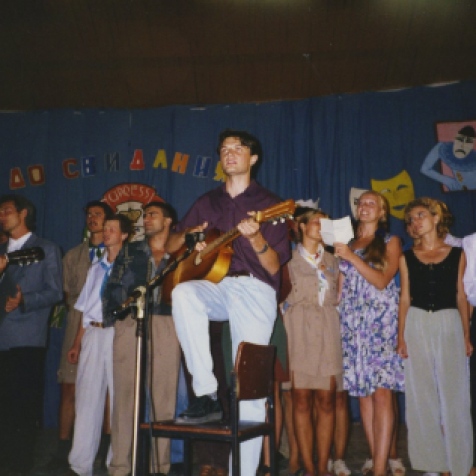
Two decades later
Travelling to Artek and spending 2 weeks as a guest vozhatiye remains one of the most extraordinary things I’ve done in my life (and I’ve done a lot since then, working as a musician in post-war countries and using music as a tool for peace and recovery). When I meet Russians or people from the former Soviet Union, I delight in telling them, “I spent some time at Artek. Do you know Artek?” The older ones know the name, and are always impressed. The younger ones – well, maybe my pronunciation is bad, but when I asked my new Russian teacher (born in 1990) this question, he thought I was saying I’d been to the Arctic!
Thinking back to that time, nearly 20 years ago, we see how much has changed. In 1996, there was no internet. How did I even find out about Artek? Why was I so determined to go there myself? I was looking for adventure and unique experiences. I knew of its prestige and its history, and wanted to be part of something that had held such pride of place in the former Soviet system.
Artek seemed to me like this glorious social experiment of bringing diverse people together to relax, play, and learn. Because of its size, some people joked that it was another of the former Soviet Union’s autonomous republics. It had its own schools! And public transport system! But it also had, in my experience, a genuine openness to connecting diverse peoples, and exploring and celebrating all their common ground. Call it a multicultural policy, perhaps.
I still hope to go back. I loved Sveta’s descriptions of Artek at Christmas time, when it would still be 20 degrees each day, and the water would still be warm. I’m sure that I will go back one day (maybe for the 100th Birthday?), and when I do, I hope that the times will be more peaceful than they are now in that part of the world. It is devastating to read of the turmoil and suffering that has taken place in Eastern Ukraine and Crimea in recent times. But when I do return, I hope that Sveta and her friends will again take me to eat arbuz. We’ll dangle our feet in the fountain, share stories, and open ourselves to the different life experiences we all bring from opposite sides of the world, and be intrigued, inspired, and changed by each other once again.

 music work